
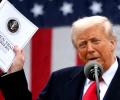
A 500 per cent tariff would effectively shut out India's goods and services exports to the US.
'The real story of 2025 is that India officially stopped being a 'market of the future' and started acting as the world's primary economic engine.'

The government on Wednesday launched Rs 4,531 crore market access support (MAS) intervention scheme for a six-year period (FY26-31) to improve global reach, visibility and competitiveness of Indian exporters through 'structured and outcome-oriented' interventions.

Talks on the proposed trade deal between India and the United States will resume after the year-end holidays, coinciding with Sergio Gor -- a close aide of American President Donald Trump -- taking charge as the US Ambassador to India in early January, according to a person privy to the development.

Mexico on Thursday imposed a tariff of up to 50 per cent on imports from its non-preferential trade partners, including India, a move that might hit New Delhi's annual $5.75 billion shipments to its third-largest car export market.

'There are very few issues and a political call needs to be taken about some of them.'
India's merchandise exports grew in the first three weeks of November compared with the same period last year, according to preliminary government data, Commerce and Industry Minister Piyush Goyal said on Tuesday. The uptick comes despite globa

India's gems & jewellery exports witnessed 30.6 per cent year-on-year (Y-o-Y) contraction in October to $2.17 million, amid the imposition of a steep 50 per cent tariff by the United States (US) on several Indian products.

India's merchandise trade deficit widened to a record $41.68 billion in October, as gold imports trebled and outbound shipments registered their sharpest contraction in 14 months, according to data released by the commerce department.
The Centre is regularly holding consultations with stakeholders to streamline foreign direct investments (FDIs) and foreign institutional investments (FIIs) related processes to enable faster and more efficient investment flows into the country, said Commerce and Industry Minister Piyush Goyal, adding one such meeting with stakeholders was held on Tuesday.

'We are now awaiting a response from the US; they have to get back to us.'

'As far as the contentious issues such as agriculture are concerned, we are finding some common ground.'

Clarity on Tata Sons' position on listing, as of 2025, would help define the future of the group better, irrespective of the RBI stand. As of now, the ball is in the RBI's court, and everyone is watching the space, points out Nivedita Mookerji.

While both sides have announced the decision to restart talks for a trade deal, government officials said discussions are continuing virtually.


'It was like rigorously preparing for a solid, good exam...' 'I don't know what marks I will get, but I felt the rigorous preparation of an exam.' 'You may sweat, but I feel rejuvenated.'

'I am doing the drive in making sure that people pass this on. So the drive is not with distrust. The drive is just in case.' 'Just in case it doesn't get passed on, I am here.'

'That is going to have an impact on literally every one, whether you buy a toothpaste, a safety pin, a car, shoes or medicines or you go to a diagnostic centre.'

'Even if tariffs are reduced, non-tariff may still remain a challenge.'
'A deal will only be possible if India stops buying Russian oil -- but even then, New Delhi must not compromise its core red lines.'
 © 2026 Rediff.com - Advertise with us - Disclaimer - Privacy Policy - Sitemap - Feedback - About us - Terms of use - Grievances